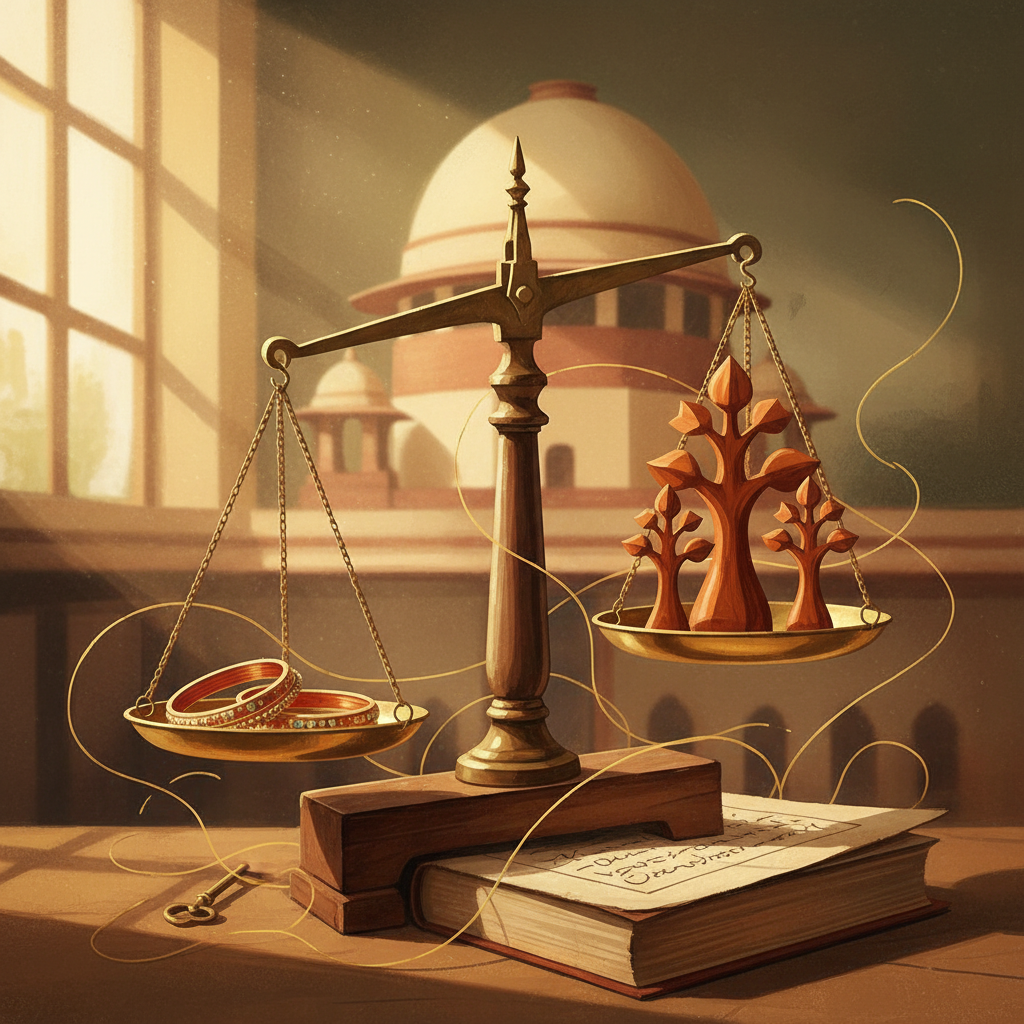
Daughters' Coparcenary Rights and Grandchildren's Claims Under the Hindu Succession Act
An analysis of the Hindu Succession (Amendment) Act 2005 regarding daughters' rights in ancestral property, alongside Supreme Court jurisprudence clarifying when grandchildren do not acquire an automatic birthright.
Understanding Coparcenary and the 2005 Amendment
Prior to the enactment of the Hindu Succession (Amendment) Act 2005, the traditional Mitakshara coparcenary system excluded daughters from acquiring property rights by birth. Coparcenary ownership was reserved strictly for male members of a Hindu Undivided Family (HUF), who acquired an undivided interest in ancestral property upon birth.
The 2005 amendment fundamentally altered this framework by substituting Section 6 of the Hindu Succession Act 1956. Under the amended Section 6, the daughter of a coparcener becomes a coparcener in her own right by birth, enjoying the exact same rights and liabilities as a son. This reform established gender parity in intestate succession of Mitakshara coparcenary property across India.
However, disputes regularly emerge regarding the devolution of property down the line—specifically concerning whether grandchildren hold an automatic birthright in property inherited by their parents or grandparents, and how daughters' shares operate upon inheritance.
Daughters as Coparceners: Equal Rights by Birth
By virtue of the amended Section 6, a daughter holds an inherent, vested right in the ancestral property of the coparcenary from the moment of her birth. This status brings several concrete legal consequences:
- Equal Share in Partition: In any notional or actual partition of coparcenary property, a daughter is entitled to the same share as a son.
- Right to Seek Partition: A daughter has the independent legal standing to demand a partition of the ancestral coparcenary property.
- Survival of Rights Post-Marriage: Marriage does not extinguish a daughter's coparcenary interest; she remains a coparcener of her father's joint family.
- Transmission of Rights: Upon the death of a female coparcener, her undivided interest devolves upon her legal heirs in accordance with the succession rules laid down in the Hindu Succession Act 1956.
While the daughter's right as a coparcener is well-settled, complexity arises when determining whether her descendants (or the descendants of a son) acquire an immediate birthright in property that devolves through succession rather than remaining joint coparcenary property.
Ancestral Property vs. Section 8 Devolution
A critical distinction exists under the Hindu Succession Act 1956 between Mitakshara coparcenary property and separate property inherited under Section 8 of the Act. Confusion frequently arises over the popular usage of the term 'ancestral property' versus its strict legal definition.
Under classical Hindu law, property inherited by a male Hindu from his father, father's father, or father's father's father was considered ancestral, conferring an automatic birthright on his sons, grandsons, and great-grandsons. However, the Supreme Court has consistently held that once the Hindu Succession Act 1956 came into force, the statutory provisions of Section 8 superseded classical Mitakshara rules regarding separate and inherited estates.
When a Hindu male dies intestate leaving behind self-acquired property, or his separate share following a partition, that property devolves upon his Class I legal heirs—including his sons, daughters, and widow—under Section 8. Property inherited under Section 8 is received by each heir in their individual, absolute capacity, rather than as joint family property.
Do Grandchildren Hold an Automatic Birthright?
The Supreme Court has clarified that a grandson or granddaughter has no birthright in property inherited by a parent under Section 8 of the Hindu Succession Act 1956.
When a father inherits property from his own father under Section 8, he takes it as separate, absolute property. Because it ceases to be joint coparcenary property in his hands, his children (the grandchildren) do not acquire any interest by birth. The parent is free to sell, gift, or bequeath the property through a will without the consent of his or her children.
The same statutory logic applies to a mother's share inherited from her father:
- Partition of Coparcenary: If a daughter receives a defined share upon the partition of an ancestral HUF property, that allotted share becomes her absolute property under Section 14 of the Hindu Succession Act 1956.
- Inheritance under Section 8: If a daughter inherits property from her deceased father under Section 8 as a Class I heir, she takes it as full owner.
- Children's Rights During Her Lifetime: In either scenario, the children of that daughter do not acquire an automatic birthright during her lifetime. Her children can only claim an interest upon her death, provided she dies intestate, pursuant to Section 15 of the Act.
Practical Implications for Title Verification and Property Transactions
For real-estate buyers, lenders, and practitioners, identifying whether property is joint coparcenary property or separate property is essential for legal due diligence:
- Tracing the Lineage of Acquisition: Title examiners must trace the mode of devolution. If the property was partitioned and held independently, or if it devolved by intestate succession under Section 8, it is not subject to birthright claims by descendants.
- Execution of Conveyances: If property is absolute and self-acquired in the hands of an owner (whether male or female), signatures of adult children or grandchildren are not legally mandated to convey marketable title.
- Surviving Coparcenary Interests: If a property remains an undivided, unpartitioned coparcenary holding, all living coparceners—including daughters—must be made confirming parties to a conveyance to extinguish all claims.
Key Legal Takeaways
The 2005 amendment granted daughters equal status as coparceners by birth in joint family property. However, once property crystallises into an individual share or devolves under Section 8 of the Hindu Succession Act 1956, it loses its coparcenary character. In such instances, grandchildren possess no birthright, and absolute ownership remains with the inheriting parent.
AI-drafted summary, editorially reviewed. Not legal advice. For specific queries, request a consultation.
Discussion
0 comments
Sign in to join the discussion.
Loading comments…